
Part 2 of 14 · Festival Water Care series
এই দশেরায় জলের ট্যাঙ্কের ১০টি লুকোনো শত্রুকে হারান
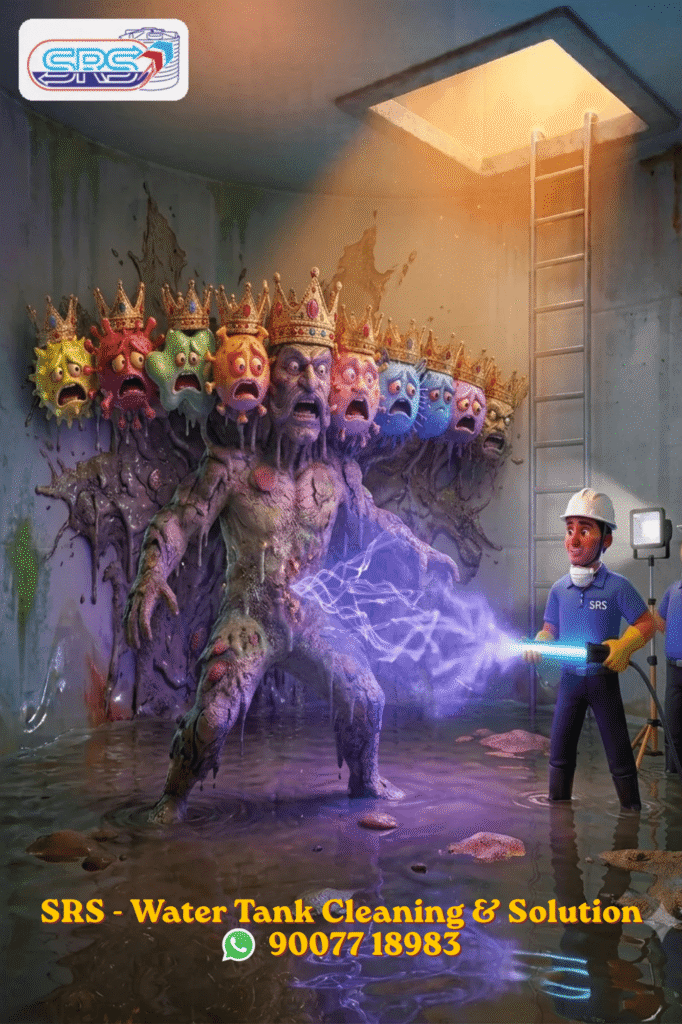
রাবণের যেমন দশটা মাথা, অনেকদিন সাফ না করা ট্যাঙ্কেও তেমনি দশটা শত্রু থাকতে পারে — ই-কোলাই, সালমোনেলা, লেজিওনেলা, সিউডোমোনাসের মতো জীবাণু, হেপাটাইটিস A আর E-র ভাইরাস, জিয়ার্ডিয়া-ক্রিপ্টোর মতো পরজীবী, শ্যাওলা, লোহা-মরচে, কাদা আর ঢাকনার নিচে কালো ছত্রাক। ওপর থেকে জল দিব্যি পরিষ্কার লাগে, কিন্তু এরা ঘাপটি মেরে থাকে তলায় আর দেওয়ালে। ছ’মাস অন্তর মেশিনে ট্যাঙ্ক সাফ করান — এদের থাকার জায়গাটাই সরিয়ে দিন। এই বিজয়া দশমীতে আপনার পরিবারের জলেও হোক অশুভের উপর শুভর জয়। শুভ বিজয়া।
Why talk about your water tank this Dussehra?
Dussehra and Bijoya Dashami remind us that good always wins over bad. In Kolkata, these are days of pujo, family visits, bhog and sweets.
Now think about the water behind all of it. It cooks the bhog. It makes tea for your guests. It bathes your children and your parents. And all of it comes from one place: the tank on your roof or under the ground.
Most of us never look inside that tank. This Dussehra, let’s take a look — not to worry, but to care.
That is why many families in Kolkata and Howrah book their Vijaya Dashami water tank cleaning right after the Puja days.
What are the 10 hidden enemies inside your water tank?
Most of these are too small to see. A “germ” simply means a tiny living thing — like bacteria, a virus or a parasite — that can make people sick. Here they are at a glance. Tap any one to read more.
- E. coli — bacteria from droppings and dirty water
- Salmonella — bacteria in old, dirty water
- Algae — the green slime near the lid
- Iron & rust — the reddish layer on the floor and walls
- Mud & sediment — the sludge at the bottom
- Hepatitis A & E — viruses that harm the liver
- Legionella — bacteria in the slimy layer of warm water
- Giardia & Cryptosporidium — tiny parasites
- Pseudomonas — bacteria in damp corners and pipes
- Fungus & mould — black spots under the lid
None of this is meant to scare you. Most tanks will not have all ten. But almost every one of them needs the same things to survive: mud at the bottom, a slimy layer on the walls, and still water that nobody checks. Take those away, and you take away their home.
1. What is E. coli, and how does it get into a water tank?
E. coli is a type of bacteria that lives in the gut of people, animals and birds. It can reach your tank through bird droppings near an open or broken lid, or through dirty water entering the supply line. Once inside, it can survive in the mud at the bottom.
- What it can do: stomach pain, cramps, vomiting and loose motions. Children and elders lose water from the body quickly, so this hits them hardest.
- What you may notice: nothing. You cannot see, smell or taste it.
- How to beat it: remove the sludge it hides in, and keep the lid tightly closed so birds can’t get near the water.
2. Why is Salmonella a worry in old, dirty water?
Salmonella is another bacteria that comes in with dirty water and droppings. It can survive for a long time in water that sits still and has mud or dirt in it.
- What it can do: typhoid and stomach infections, with fever, stomach pain and loose motions.
- What you may notice: nothing. Like E. coli, it is invisible.
- How to beat it: don’t let old water and mud sit in the tank for years. A clean every 6 months keeps the tank from becoming its home.
3. Why does green slime (algae) grow inside the tank?
Algae are tiny plants. Like all plants, they need light. They grow wherever sunlight gets in — through a gap, a cracked lid or a thin, see-through tank wall.
- What it can do: makes the water taste and smell bad, and becomes food for other bacteria. Some blue-green types can release substances that irritate the skin.
- What you may notice: green or dark slime near the lid and on the upper walls.
- How to beat it: high-pressure cleaning strips it off the walls. Afterwards, keep the lid closed and fix any cracks so light stays out.
4. Why is my tank water yellow or red? (Iron & rust)
Many water supplies carry dissolved iron. Over time it settles as a reddish-brown layer on the tank floor. In PVC (Sintex-type) tanks, this iron and sediment layer sticks hard to the walls.
- What it can do: yellow or red water, a metallic taste, and stains on clothes, buckets and bathroom tiles. It also chokes water purifier filters. Iron is mainly a taste and stain problem — but a rough, rusty layer gives bacteria an easy surface to stick to.
- What you may notice: yellowish water, orange stains, or red-brown particles in your filter.
- How to beat it: in PVC tanks, a cleaning chemical loosens the layer before pressure-washing. Cement (RCC) tanks don’t need this chemical.
5. What is the mud (sludge) at the bottom of my tank?
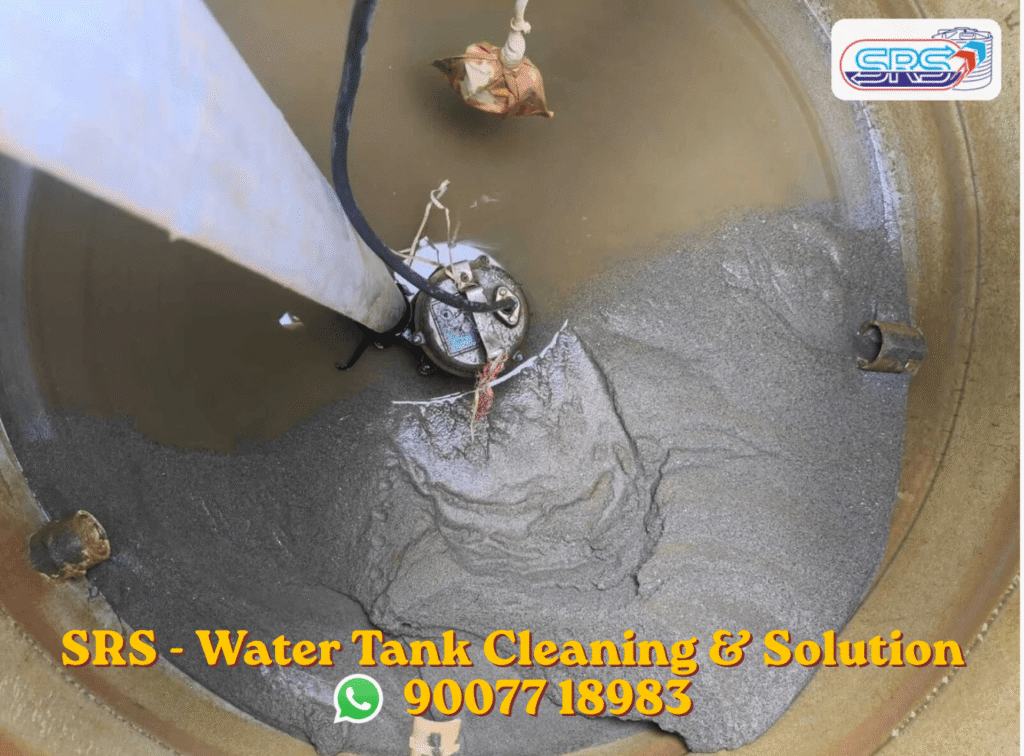
Sand, silt, rust and dust come in with the water every day. They are too heavy to float, so they slowly settle at the bottom — month after month — into a thick layer of sludge.
- What it can do: spoils the taste and smell of the water, clogs filters and taps, and gives bacteria a dark, safe place to hide and grow.
- What you may notice: sand in your bucket, or muddy water just after the tank refills or when the water level is low.
- How to beat it: it has to be physically taken out — by sludge removal and vacuum cleaning. Draining the water alone leaves it behind.
6. Can a water tank spread hepatitis?
Hepatitis A and E are viruses that spread through water mixed with sewage. They can enter through a leaking pipe or an open, uncovered tank.
- What it can do: they attack the liver, causing jaundice (yellow eyes and skin), tiredness and loss of appetite.
- What you may notice: nothing in the water itself.
- How to beat it: to be honest, a clean tank alone cannot fix a dirty supply line. But a clean tank with a tightly closed lid removes one more way in. If you suspect a leak or sewage smell, get the pipes checked too.
7. What is Legionella, and why does it matter in a warm tank?
Legionella is a bacteria that lives in the slimy layer (biofilm) on tank walls and pipes. It grows best in warm water, roughly between 20°C and 45°C. A rooftop tank in a Kolkata summer can easily reach that range.
- What it can do: it does not harm you by drinking. The risk comes from breathing in tiny water droplets — for example, while bathing under a shower. This can cause a serious lung infection. Elders and people with weak immunity are at higher risk.
- What you may notice: a slimy feel on the tank walls.
- How to beat it: high-pressure cleaning removes the slimy layer it feeds on, and the H2O2 spray treats the walls after.
8. What are Giardia and Cryptosporidium?
These are parasites — tiny living things that live off a person’s body. They enter the tank through dirty water and can survive in water for a long time. Some of them are not easily killed by ordinary chlorine.
- What it can do: they attack the intestines, causing loose motions that can last for weeks, weight loss and weakness. Small children suffer the most.
- What you may notice: nothing.
- How to beat it: keep the tank free of the mud and old water where they can settle and wait.
9. What is Pseudomonas?
Pseudomonas is a bacteria that loves damp corners, pipes and the slimy layer inside tanks.
- What it can do: when you bathe or wash your face with this water, it can cause eye infections, ear pain and skin rashes.
- What you may notice: a slimy feel on walls and pipes.
- How to beat it: clean the corners and walls properly — not just the floor — and treat them with anti-bacterial spray.
10. Why are there black spots under my tank lid? (Fungus & mould)
The underside of the lid and the corners near the top stay damp but are rarely touched. That is where fungus and mould grow.
- What it can do: gives the water a musty smell. For people with asthma or allergies, mould can trigger breathing trouble and skin allergies.
- What you may notice: black, grey or green spots under the lid and in the top corners.
- How to beat it: clean the ceiling and the lid too, not only the floor. A proper clean covers walls and ceiling.
You can’t see most of them — but you can remove the places where they live. A dirty tank gives them mud, slime and still water to hide in and grow. A clean tank takes that home away.
How does a proper clean defeat these enemies?
Draining the water and scrubbing with a brush is not enough. SRS has used the same 6-stage mechanized process since 2017:
- Mechanized de-watering — pumps out the old stored water, even below the foot-valve level.
- Sludge removal — sucks out the mud and sediment from the floor.
- High-pressure cleaning — jet cleaners strip algae, rust deposits and the slimy layer (biofilm) from the walls and ceiling.
- Vacuum cleaning — an industrial vacuum takes away all the loosened dirt.
- Anti-bacterial treatment — walls and ceiling are sprayed with hydrogen peroxide (H2O2).
- UV radiation sterilization — UV light kills bacteria still left in the tank, like the final arrow.
Are PVC tanks and cement tanks cleaned the same way?
Not exactly. In PVC (Paton/Sintex-type) tanks, iron and sediment form a layer stuck to the walls, so we use a cleaning chemical to loosen it. Cement (RCC) tanks don’t need this chemical. Every tank, PVC or cement, gets the H2O2 anti-bacterial spray and then UV sterilization.
What can you do at home between cleanings?
- Keep the tank lid closed and tight. Replace it if it is broken or cracked.
- Watch for warning signs: muddy or yellow water, sand in buckets, a bad smell, or green slime near the lid. See the full list in How Often Should You Clean Your Water Tank in Kolkata?
- Note the date of your last cleaning, so you know when the next one is due.
When should you book your next tank cleaning?
Every 6 months. Kolkata’s humid weather makes algae and bacteria grow faster. After the pujo holidays, with Diwali and Kali Puja coming, many families like to have clean water before guests arrive.
From our base in Haltu, SRS teams serve homes, apartments and offices across Kolkata and Howrah — including Behala, Garia, Salt Lake and Howrah. Housing societies, schools and offices can choose an AMC (Annual Maintenance Contract), and we send a WhatsApp reminder when the next cleaning is due.
Frequently asked questions
What hidden enemies can live inside a water tank?
Germs like E. coli, Salmonella and Pseudomonas, viruses like Hepatitis A and E, parasites, algae, mud, rust, a slimy biofilm and mould. Most of them hide in the mud and slime at the bottom and on the walls.
Can a water tank look clean but still be dirty?
Yes. The water can look clear from the top, while mud sits on the floor and bacteria stick to the walls as a slimy layer.
How often should I clean my water tank in Kolkata?
Every 6 months. Clean it sooner if you see muddy water, a bad smell, algae or insects.
Does SRS use chemicals?
A cleaning chemical is used only in PVC tanks, to loosen the iron and sediment layer. Cement (RCC) tanks don’t need it. Every tank gets a hydrogen peroxide (H2O2) anti-bacterial spray, followed by UV sterilization.
Does SRS clean water tanks in Howrah too?
Yes. SRS – Water Tank Cleaning & Solution works across Kolkata and Howrah.
Ready for your Vijaya Dashami water tank cleaning? SRS – Water Tank Cleaning & Solution offers mechanized tank cleaning across Kolkata and Howrah.
Book a tank cleaning in Kolkata
Available 24×7 — call or WhatsApp anytime; our team can also attend urgent tank cleaning at any hour. Send your area, tank type and size on WhatsApp — most messages get a reply within 30 minutes.
Book on WhatsApp WhatsApp-এ বুক করুন Call nowFestival Water Care series: all parts
- How Often Should You Clean Your Water Tank in Kolkata?
- This Dussehra, Defeat the 10 Hidden Enemies Inside Your Water Tank
- Underground Reservoir Cleaning After Monsoon: What Kolkata Homes Miss
- PVC (Sintex) vs Cement Tank: Why the Cleaning Method Is Different (coming soon)
- Diwali Guests Coming? Light Up Your Home and Clean Your Water Tank First (coming soon)
Related services: Residential Tank Cleaning → · Apartment Tank Cleaning → · Commercial Tank Cleaning & AMC → · All FAQs →