Part 4 of 14 · Festival Water Care series
প্লাস্টিক (PVC) বনাম সিমেন্টের ট্যাঙ্ক: পরিষ্কারের পদ্ধতি কেন আলাদা
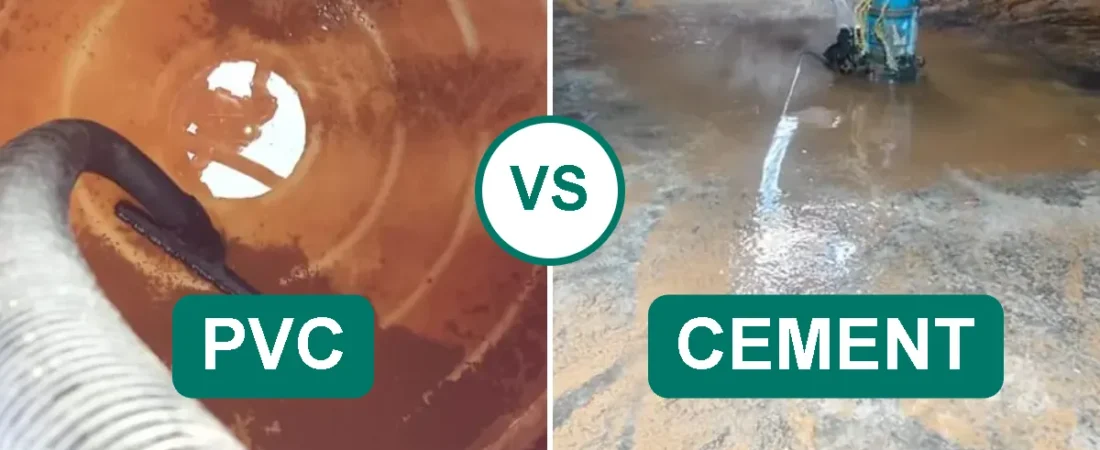
প্লাস্টিকের (PVC) আর সিমেন্টের ট্যাঙ্কে ময়লা আলাদা ভাবে জমে। প্লাস্টিকের ট্যাঙ্কের দেওয়ালে আয়রন আর সেডিমেন্টের লেয়ার জমে যায়, তাই পরিষ্কারের সময় সেই লেয়ারের বন্ড হালকা করতে ক্লিনিং কেমিক্যাল ব্যবহার করা হয়। প্লাস্টিকের ট্যাঙ্কে এই লেয়ার তাড়াতাড়ি আর মোটা হয়ে জমে, মাঝে মাঝে ফাটল ধরে, আর সেই ফাটলে জীবাণু জন্মায়। সিমেন্টের ট্যাঙ্কে এই কেমিক্যাল লাগে না, সিমেন্টের ট্যাঙ্ক প্রেশার জেট দিয়ে পরিষ্কার করা হয়। পরিষ্কারের পর দুই ধরনের ট্যাঙ্কেই H2O2 অ্যান্টি-ব্যাকটেরিয়াল স্প্রে আর UV-রে (UV ল্যাম্প টাইপ-C) দিয়ে জীবাণুমুক্ত করা হয়। প্রতি ৬ মাসে একবার পরিষ্কার করান, পরিবারের সুস্থতার জন্য।
From the outside, a water tank is just a water tank. But inside, a plastic (PVC) tank and a cement tank collect dirt in very different ways. That is why a proper clean is not the same for both. Here is what changes, what stays the same, and what it means for your family’s water.
Is your water tank plastic (PVC) or cement (RCC)?
Most homes in Kolkata and Howrah have one of these two kinds of tank. Many buildings have both.
PVC simply means a plastic tank. Sintex is the name of a well-known company that makes these tanks, so in Kolkata many people call any plastic water tank a “Sintex tank”, whatever the brand. In this post, a “Sintex tank” just means a plastic PVC tank. SRS is an independent cleaning service and cleans plastic tanks of every brand.
| PVC (plastic) tank | Cement (RCC) tank | |
|---|---|---|
| Made of | Plastic, moulded in one piece | Concrete with steel rods inside. RCC means Reinforced Cement Concrete. |
| Where you usually see it | On the roof of a house or a small building | Underground reservoirs, and built-in roof tanks in many apartments |
| Shape | Round, with rings on the walls | A square or rectangular room |
A house in Behala may have a plastic (PVC) tank on the roof. An apartment block in Salt Lake or Howrah often has a cement underground reservoir as well. If you are not sure what you have, that is fine. Just tell us when you book.
What builds up inside a plastic (PVC) tank?
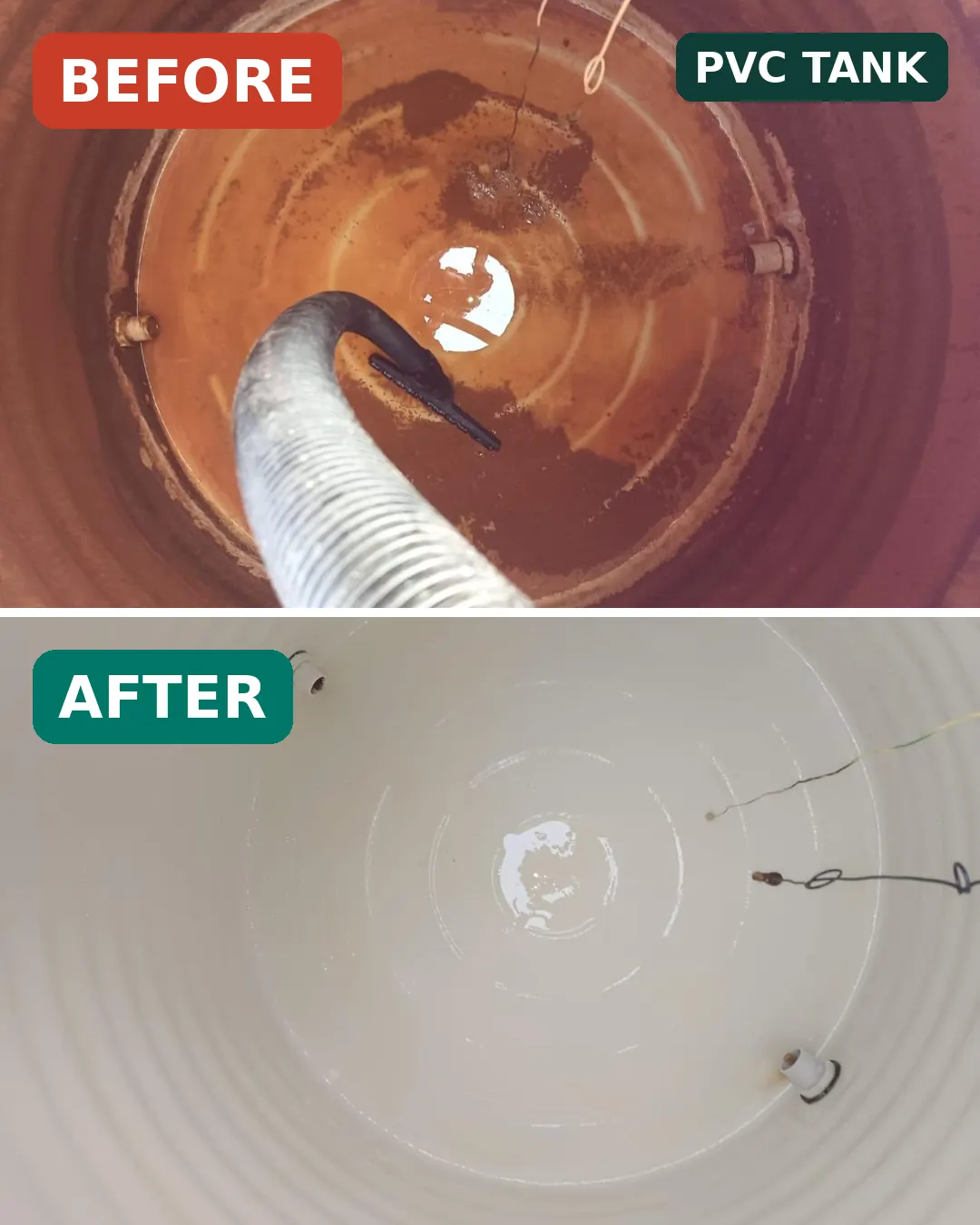
The water that fills your tank carries tiny bits of iron and sediment. In a plastic tank, these slowly stick to the walls. Over the months they form a brown or yellow layer, like the one in the photo above.
In plastic tanks, this iron and sediment layer builds up quickly, and it can become thick. Over time, small cracks form in the layer. Germs and bacteria can grow inside these cracks, where the water keeps touching them every day. That is why a plastic tank should not be left for long without a proper clean.
This layer holds on to the plastic. So during Sintex tank cleaning, a cleaning chemical is used to loosen it. Once it is loose, high-pressure cleaning and an industrial vacuum take it out.
What builds up inside a cement (RCC) tank?
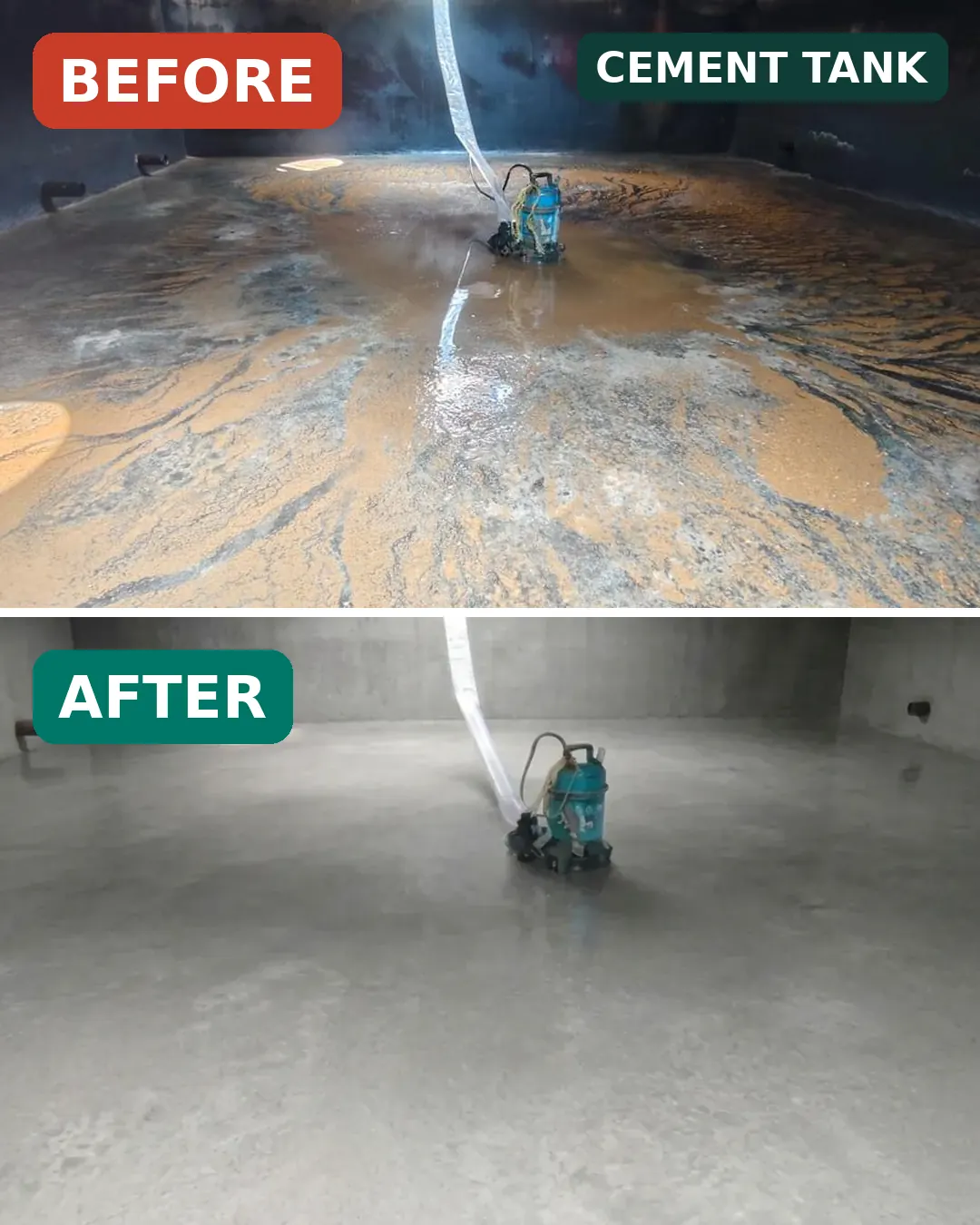
In a cement tank, most of the dirt sinks to the floor. It settles as sludge, sand and mud. Underground reservoirs collect the most, especially after the monsoon. Green algae and slime can also grow on the walls near the lid.
This dirt is removed with pumps, sludge removal, high-pressure cleaning and vacuum cleaning. A cement tank does not need the extra chemical step. To learn more, read our post on underground reservoir cleaning after the monsoon.
Why is a chemical used in a plastic (PVC) tank but not in a cement tank?
It comes down to the kind of dirt. In PVC tanks, a cleaning chemical is used during cleaning to loosen the iron and sediment layer stuck to the walls. Cement (RCC) tanks do not need this chemical, because their dirt mostly lies on the floor.
So the method is matched to your tank. When you book, tell us if your tank is plastic (PVC) or cement, and our team will come ready for it.
What is the same for every tank?
Whatever your tank is made of, SRS follows the same 6-stage mechanized process:
- Mechanized de-watering: the water is pumped out.
- Sludge removal: the settled sludge on the floor is sucked out.
- High-pressure cleaning: jet cleaners strip deposits, algae and slime off the walls.
- Vacuum cleaning: an industrial vacuum removes the loosened dirt.
- Anti-bacterial treatment: walls and ceiling are sprayed with hydrogen peroxide (H2O2).
- UV radiation sterilization: UV light from a UV-C lamp kills the bacteria still left in the tank.
Every tank, PVC or cement, gets the H2O2 anti-bacterial spray after cleaning, and then UV sterilization with a UV-C lamp.
PVC vs cement tank cleaning: what are the 2 key differences?
There are 2 key differences: the kind of dirt, and whether a cleaning chemical is needed. Everything else is the same.
| PVC (plastic) tank | Cement (RCC) tank | |
|---|---|---|
| Main dirt | Iron and sediment layer stuck to the walls | Sludge, sand and mud on the floor; algae near the lid |
| How fast iron builds up | Quickly, as a thick layer that can crack | Comparatively less |
| Cleaning chemical to loosen dirt | Yes | Not needed |
| H2O2 anti-bacterial spray | Yes | Yes |
| UV-C sterilization | Yes | Yes |
| How often to clean | Every 6 months | Every 6 months |
| Usual time | 40 to 60 minutes for an overhead tank up to 2,000 litres | 40 to 60 minutes for an overhead tank up to 2,000 litres; about 1 to 1.5 hours for an underground tank |
How often should you get Sintex tank cleaning done?
Every 6 months, for both plastic (PVC) and cement tanks. Kolkata’s humid weather helps dirt and germs build up faster. Read why in how often you should clean your water tank in Kolkata.
Do not wait for the 6 months if you notice any of these:
- Brown, yellow or muddy water from the taps
- Sand or rust in buckets or in your water purifier filter
- A smell from the water
- A slimy feel on the tank walls near the lid
A clean tank means peace of mind every time your child drinks a glass of water, or an elderly parent takes medicine with it.
Frequently asked questions
Is Sintex tank cleaning different from cement tank cleaning?
Yes. In plastic (PVC) tanks, a cleaning chemical is used to loosen the iron and sediment layer stuck to the walls. Cement (RCC) tanks do not need it. After cleaning, every tank gets an H2O2 anti-bacterial spray and UV-C sterilization.
How long does Sintex tank cleaning take?
An overhead tank of up to 2,000 litres, PVC or cement, usually takes 40 to 60 minutes. An underground tank usually takes about 1 to 1.5 hours.
How often should I clean a plastic (PVC) or cement water tank?
Every 6 months. Clean it sooner if the water looks muddy or yellow, smells, or you see sand in your buckets.
Do you clean both plastic (PVC) and cement tanks in Kolkata and Howrah?
Yes. SRS – Water Tank Cleaning & Solution cleans plastic (PVC) tanks of every brand and cement (RCC) tanks, overhead and underground, in homes, apartments and offices across Kolkata and Howrah.
Which water tank is best for home, plastic or cement?
Both plastic (PVC) and cement tanks are used in homes across Kolkata and Howrah. From a cleaning point of view, a plastic tank builds up an iron and sediment layer quickly. The layer can become thick and crack, and germs can grow inside those cracks. A cement tank collects comparatively less iron, but sludge and sand settle on its floor. Whichever tank you have, clean it every 6 months. SRS cleans both.
Not sure if your tank is plastic (PVC) or cement? Send your area, tank type and size on WhatsApp at 9007718983. Our team handles Sintex tank cleaning and cement tank cleaning across Kolkata and Howrah.
Is your tank plastic (PVC) or cement? We clean both.
Send your area, tank type and size on WhatsApp — most messages get a reply within 30 minutes.
Book on WhatsApp WhatsApp-এ বুক করুন Call nowFestival Water Care series: all parts
- How Often Should You Clean Your Water Tank in Kolkata?
- This Dussehra, Defeat the 10 Hidden Enemies Inside Your Water Tank
- Underground Reservoir Cleaning After Monsoon: What Kolkata Homes Miss
- Plastic (PVC) vs Cement Tank: Why the Cleaning Method Is Different
- Diwali Guests Coming? Light Up Your Home and Clean Your Water Tank First
- This Bhai Phonta, Protect Your Family’s Health with Safe Water (coming soon)
- Chhath Puja and the Purity of Water: Start at Home (coming soon)
Related services: Residential Tank Cleaning → · Apartment Tank Cleaning → · Commercial Tank Cleaning & AMC → · All FAQs →