Part 7 of 14 · Festival Water Care series
ছট পূজা ও জলের পবিত্রতা: শুরু হোক নিজের ঘর থেকে
ছট পূজা মানেই শুদ্ধতা: স্নান, প্রসাদ, সূর্যদেবকে অর্ঘ্য। বাড়িতে এই সব জলই আসে ছাদের জলের ট্যাংক থেকে। ওপর থেকে জল পরিষ্কার লাগলেও ট্যাংকের তলায় আয়রন, সেডিমেন্ট, এলগি আর কাদা জমে থাকে। প্রতি ৬ মাসে একবার ৬-স্টেজ ম্যাকানাইজড পদ্ধতিতে ট্যাংক পরিষ্কার করান। শুদ্ধতা শুরু হোক নিজের ঘর থেকে।

Why does clean water matter so much during Chhath Puja?
Chhath is one of the most disciplined festivals we celebrate. Every step asks for purity: of the body, of the food and of the home.
- Nahay Khay: the day begins with a holy bath and a simple, satvik meal.
- Kharna: the family prepares kheer and roti as prasad, cooked with great care.
- Arghya: water is offered to the setting Sun in the evening and to the rising Sun the next morning.
Families clean every corner of the house, wash every utensil twice and cook prasad like thekua with complete devotion. Yet one thing in the house is almost always forgotten: the water tank on the roof.
Where does the water in your home actually come from?
In most Kolkata and Howrah homes, the water you use for bathing, cooking and washing does not come straight from the supply line. It is first stored in a tank:
- Supply water, or water from an underground reservoir, is pumped up.
- It is stored in the overhead tank on your roof.
- From there it flows to every tap in your kitchen and bathroom.
So the bath you take on Nahay Khay and the water you use to cook prasad all pass through that one tank. If the tank is not clean, the purity you work so hard for begins with water that is not.
What can be hiding inside a tank that looks clean?
Open the lid and the water may look fine. The problem sits at the bottom and on the walls, where nobody looks:
- Iron and rust: a reddish-brown layer, very common in old pipes and in PVC (plastic) tanks.
- Sediment and mud: fine sand and silt that settle slowly, layer by layer.
- Algae: green or dark patches, especially where sunlight gets in.
- Slime on the walls: a slippery layer you can feel if you touch the inside of the tank.
Over months these layers build up. When the water level drops or the pump starts, some of this dirt is stirred up and reaches your taps.
What simple checks can you do before the festival?
You do not need any equipment. Just check:
- Smell: does the tap water smell musty or like iron?
- Colour: fill a white bucket. Is the water slightly yellow or brown?
- Tap dirt: do you see small particles at the bottom of the bucket?
- Feel: does the inside of the tank feel slimy?
- Date: when was the tank last cleaned? If it was more than 6 months ago, it is due.
If even one answer worries you, get the tank cleaned. Read more in our guide on how often you should clean your water tank.
How does SRS clean an overhead tank?
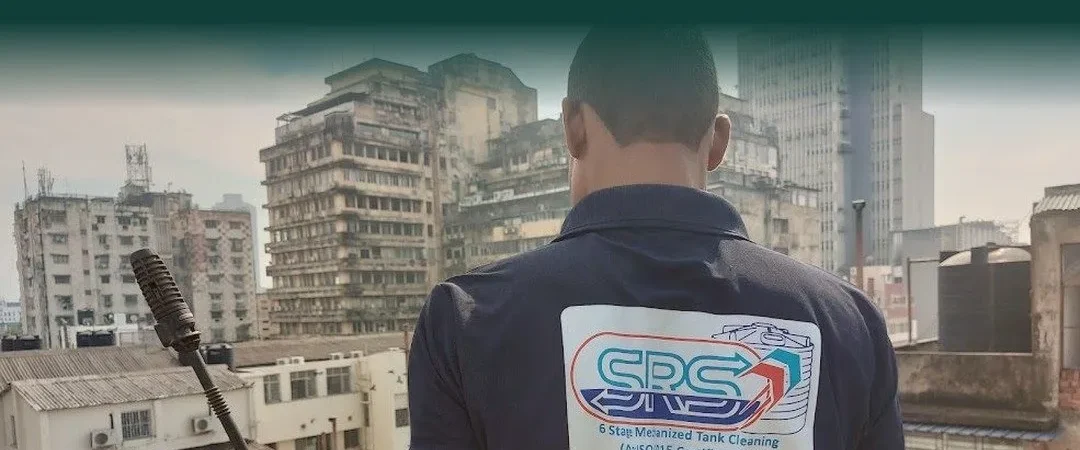
SRS – Water Tank Cleaning & Solution has been cleaning water tanks across Kolkata and Howrah since 2017, from Behala and Garia to Salt Lake and New Town. Our ISO 9001:2015 certified team follows a 6-stage mechanized process:
- Mechanized De-watering: the remaining water is pumped out.
- Sludge Removal: mud and sediment are taken out from the bottom.
- High-Pressure Cleaning: walls and floor are washed with a pressure jet.
- Vacuum Cleaning: a wet vacuum lifts out the loosened dirt and dirty water.
- Anti-Bacterial Treatment: an H2O2 anti-bacterial spray is applied after cleaning.
- UV Radiation Sterilization: a UV-C lamp is used as the final step.
For plastic (PVC) tanks, we use a cleaning chemical to loosen the iron and sediment layer. Cement tanks do not need it. Every tank gets the H2O2 spray and UV sterilization at the end. See why the method differs for PVC and cement tanks.
How often should you clean your water tank?
Every 6 months is the safe interval for most homes. If your area gets muddy supply water, or your tank is old, check it more often. Festivals like Chhath, Diwali and Bhai Phonta are a good reminder, because that is when your family uses the most water at home.
If your building also has an underground reservoir, clean it too, because it feeds the overhead tank. Read: Underground reservoir cleaning after monsoon.
Frequently asked questions
Is it okay to use tank water for cooking prasad?
Yes, as long as the tank is cleaned regularly. Most families cook with tap water that comes from the overhead tank. If your tank has not been cleaned in over 6 months, get it cleaned before the festival.
How long does overhead tank cleaning take?
It depends on the size of the tank. A normal home tank is usually done the same day, and you can use water again once the cleaning is complete.
Does SRS use chemicals in every tank?
No. A cleaning chemical is used only in PVC (plastic) tanks, to loosen the iron and sediment layer. Cement tanks are cleaned without it. Every tank gets an H2O2 anti-bacterial spray and UV-C sterilization after cleaning.
Can SRS come during the festival days?
Yes. SRS is available 24×7 — call or WhatsApp anytime; our team can also attend urgent tank cleaning at any hour.
This Chhath, let purity begin at home
Available 24×7 — call or WhatsApp anytime; our team can also attend urgent tank cleaning at any hour. Send your area, tank type and size on WhatsApp — most messages get a reply within 30 minutes.
Book on WhatsApp WhatsApp-এ বুক করুন Call nowIs Your Water Tank Making Your Family Sick? 7 Warning Signs to Check Today
Get notified on WhatsApp
Festival Water Care series: all parts
- How Often Should You Clean Your Water Tank in Kolkata?
- This Dussehra, Defeat the 10 Hidden Enemies Inside Your Water Tank
- Underground Reservoir Cleaning After Monsoon: What Kolkata Homes Miss
- Plastic (PVC) vs Cement Tank: Why the Cleaning Method Is Different
- Diwali Guests Coming? Light Up Your Home and Clean Your Water Tank First
- This Bhai Phonta, Protect Your Family’s Health with Safe Water
- Chhath Puja and the Purity of Water: Start at Home
- Is Your Water Tank Making Your Family Sick? 7 Warning Signs to Check Today (coming soon)
Related services: Residential Tank Cleaning → · Apartment Tank Cleaning → · Commercial Tank Cleaning & AMC → · All FAQs →